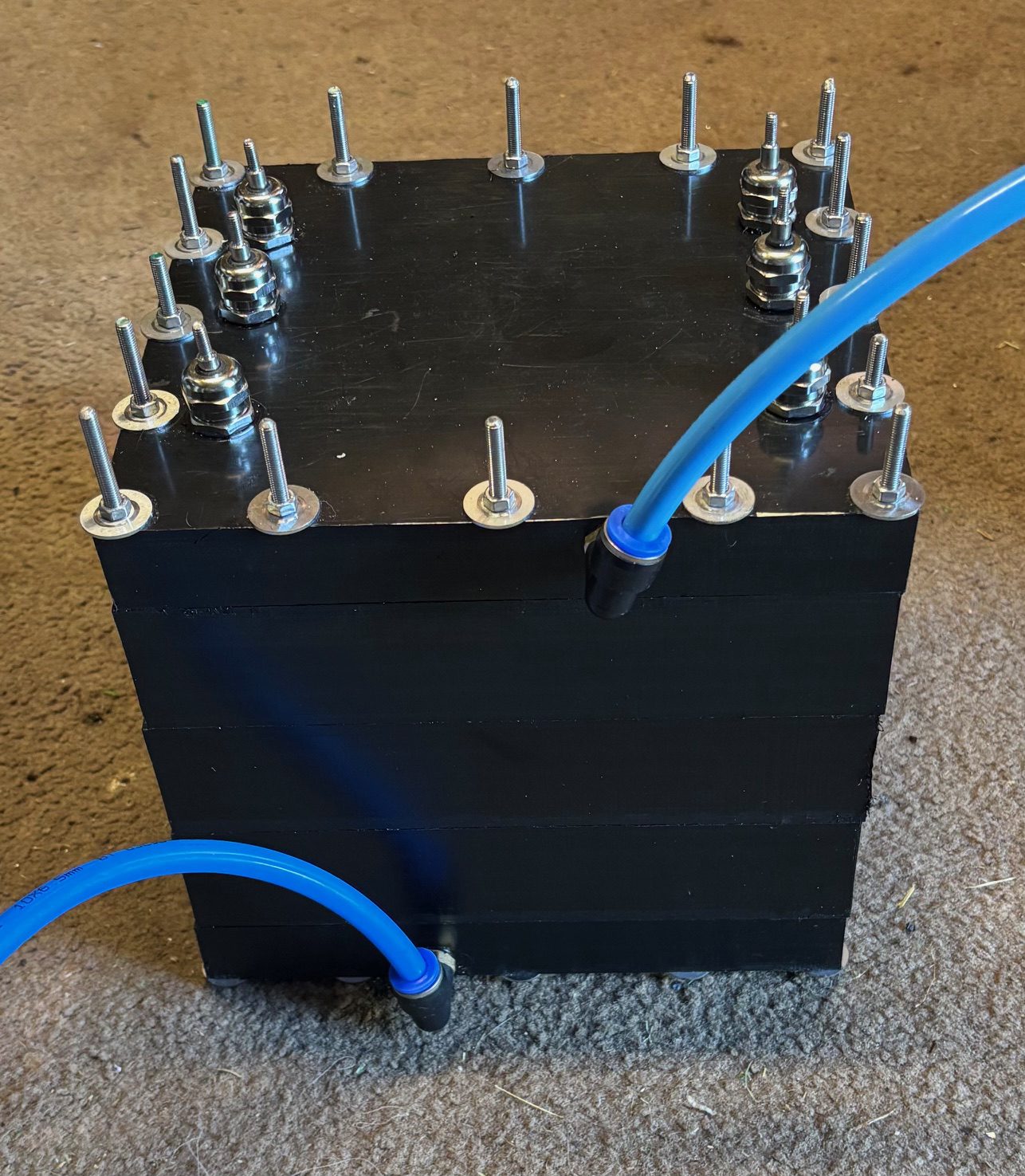
The Photo above shows the heart of the Gen 25 Hydrogen fuel system. This Unit is 250% larger than the Electrolysis cell that is used to power the Gen 20 Hydrogen fuel system that unit
The Gen 25 Hydrogen fuel system has been designed for very large diesel engines and in particular for engines with engine capacity up to and greater that 20 liter capacity. The Gen 25 System is based on the highly successful Gen 20 Hydrogen fuel system Design but has been increased in size , current carrying capacity and Gas output. The Electrode plate area of the Gen 20 Hydrogen fuel system has been increased from 6800 square cm to 16200 square cm – over double the electrode area of the Gen 20 Hydrogen fuel system. The current capacity has increased and the Gas output rate has massively increased as well. A major advantage of this larger Gen 25 System is that it is far more efficient and able to produce far more gas without increasing the current and Voltage input very much.
Gen 25 Hydrogen fuel system can be used on smaller truck engines , producing more hydrogen gas than the stoichiometric volume required for efficient engine operation.
This extra gas output cleans the engine internally and puts a smaller load on the engine Generator/ alternator / battery system to provide the hydrogen required.
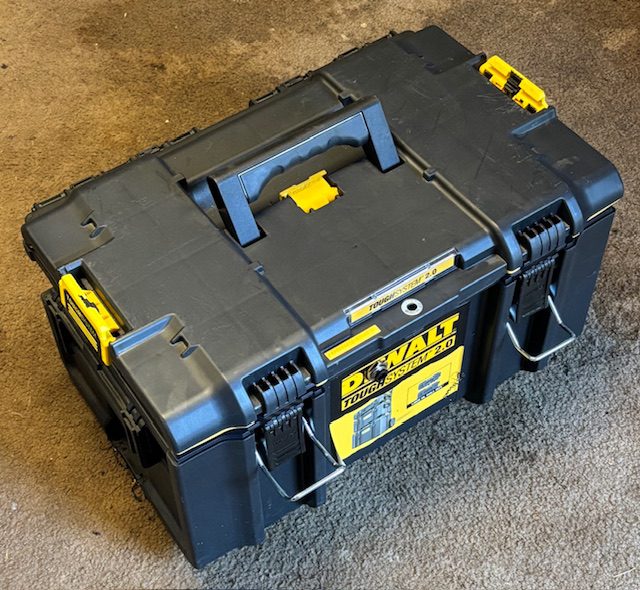
The Gen 25 Hydrogen fuel system can be fitted to a Dewalt Toughbox 2, or installed into a steel or aluminum enclosure box measuring 45 cm x 30 cm x 30 cm.
Mounted into a Dewalt Toughbox 2 , the complete system is firstly mounted onto a Toughened steel box arrangement which is then lowered and secured into the Dewalt Toughbox 2. This arrangement is stonger and more rhobust than Mounting into the Dewalt Toughbox 2 alone. The Dewalt Toughbox 2 is a specially designed plastic and structural design for rough handling resistance.
The Gen 25 Hydrogen fuel system can handle increased current flow and much greater gas output.
A further modification of the Gen 25 Hydrogen fuel system is the Gen 20 Hydrogen fuel system PLUS with an even greater electrode surface area of 21400 sq cm – equivalent to three Gen 20 Hydrogen fuel systems in plate area and Gas Production. These Gen 25 systems are installed with the 2.5 kW power supply.
Go to the SHOP to purchase Gen 25 Hydrogen fuel system
Photos of the Gen 25 Hydrogen fuel system are installed on this webpage below-
Up to 6 plus Liters of gas per minute
Voltage
12 Volts (+/- 2v) Standard fitment
Current Range
35 to 40 Amps
Engine Suitability
Very large heavy loaded Trucks Engines up to 20 Litres PLus
Type of Usage
Highway
City Drive
Off Highway
Static
Gen 25 Hydrogen fuel system – Fuel Savings
(Applicable to Diesel Vehicles Only) (Note: Fuel savings are dependent on various factors and cannot be rigidly fixed to any one specific number. For Petrol vehicles, no specific testing has been conducted yet, hence savings data or the amount of Hydrogen needed for savings is yet to be determined.)
The results shown below have been obtained from independently tested vehicles , 2.8 litre cars to 7.8 Litre trucks. Photos of these late model vehicles is show in Images on this website.
Highway Driven Vehicles: Up to 32% ( test reports in a 27 tonne 7.2 L 2022 truck- see webpage)
City Driven Vehicles: Up to 32% ( test reports in a 27 tonne 7.2 L 2022 truck- see webpage)
Off Highway: Up to 32% ( test reports in a 27 tonne 7.2 L 2022 truck- see webpage)
Static: Up to 32% ( test reports in a 27 tonne 7.2 L 2022 truck- see webpage)
Gen 25 Hydrogen fuel system – Emission Reduction
CO2 Savings: Up to 57% reduction in net CO2 addition. ( test reports in a 27 tonne 7.2 L 2022 truck- see webpage)
Gen 25 Hydrogen fuel system – Voltage Requirements for 24V Vehicles
Gen 25 Hydrogen fuel system have standard 12V fitment and cannot be used for 24V Vehicles. Use K40 if your vehicle has 24V power supply.
24 V vehicles can use a Redarc 24V/12V converter
Gen 25 Hydrogen fuel system – System Servicing
The first service is required after 3 months of use. Subsequent servicing is recommended every 6 months
Gen 25 Hydrogen fuel system – System Life
Although not fully tested, the expected lifespan of the system is projected to be more than 5 years.
Gen 25 Hydrogen fuel system Physical Dimensions – Mounted into Welded Steel, Aluminum enclosure box or Dewalt ToughBox 2 (53 cm x 35 cm x 35 cm)
Width: 30 cm
Length: 43 cm
Height: 35 cm
System Weight
Empty System: 22kg
Fully Filled System: 28kg
Latest developments for these systems include the use of new Resin filter system to increase the purity of the water electrolyte . This development removes impurities from the water to produce Chemistry laboratory grade distilled to produce a purity of 52ppm from tap-water (800pm) or ground water 1500 ppm.
Removing impurities prevents any unwanted oxidation of the anode of an electrolysis unit , producing more gas for the electrical energy input and wasting much less energy as heat.
The Resin filter capsule is able to produce 50,000 litres of pure water and has a lifespan of 5000 hours. The Capsule is easily replaced / serviced with a new filter module. Contact Gavan on 0403177183 for more information of this produce. Photos of the resin filter is seen on the “Shop” on this site.
For more detailed information or any specific queries, please feel free to contact our technical support team.
Contains custom information set by the web developer via the _setCustomVar method in Google Analytics. This cookie is updated every time new data is sent to the Google Analytics server.
2 years after last activity
__utmx
Used to determine whether a user is included in an A / B or Multivariate test.
18 months
_ga
ID used to identify users
2 years
_gali
Used by Google Analytics to determine which links on a page are being clicked
30 seconds
_ga_
ID used to identify users
2 years
_gid
ID used to identify users for 24 hours after last activity
24 hours
_gat
Used to monitor number of Google Analytics server requests when using Google Tag Manager
1 minute
__utmt
Used to monitor number of Google Analytics server requests
10 minutes
__utmb
Used to distinguish new sessions and visits. This cookie is set when the GA.js javascript library is loaded and there is no existing __utmb cookie. The cookie is updated every time data is sent to the Google Analytics server.
30 minutes after last activity
__utmc
Used only with old Urchin versions of Google Analytics and not with GA.js. Was used to distinguish between new sessions and visits at the end of a session.
End of session (browser)
__utmz
Contains information about the traffic source or campaign that directed user to the website. The cookie is set when the GA.js javascript is loaded and updated when data is sent to the Google Anaytics server
6 months after last activity
_gac_
Contains information related to marketing campaigns of the user. These are shared with Google AdWords / Google Ads when the Google Ads and Google Analytics accounts are linked together.
90 days
__utma
ID used to identify users and sessions
2 years after last activity
SourceBuster is used by WooCommerce for order attribution based on user source.
Name
Description
Duration
sbjs_current_add
Timestamp, referring URL, and entry page for your visitor’s current visit to your store
session
sbjs_migrations
Technical data to help with migrations between different versions of the tracking feature
session
sbjs_session
The number of page views in this session and the current page path
30 minutes
sbjs_udata
Information about the visitor’s user agent, such as IP, the browser, and the device type
session
sbjs_first
Traffic origin information for the visitor’s first visit to your store (only applicable if the visitor returns before the session expires)
session
sbjs_current
Traffic origin information for the visitor’s current visit to your store
session
sbjs_first_add
Timestamp, referring URL, and entry page for your visitor’s first visit to your store (only applicable if the visitor returns before the session expires)
session
Marketing cookies are used to follow visitors to websites. The intention is to show ads that are relevant and engaging to the individual user.
Google Maps is a web mapping service providing satellite imagery, real-time navigation, and location-based information.