Brilliant Invention Gen 20 Hydrogen Generator
Brilliant Invention Gen 20 Hydrogen Generator ---update Feb 7... Full Story
Perth, West Australia





D.Sa ´ inz, P.M. Die ´guez, C. Sopena , J.C. Urroz, L.M. Gandı´a*
Escuela Te ´cnica Superior de Ingenieros Industriales y de Telecomunicacio ´n, Universidad Pu ´blica de Navarra, Campus de Arrosadı´a, E-31006 Pamplona, Spain
Bi-fuel internal combustion engine vehicles allowing the operation with gasoline or diesel and hydrogen have great potential for speeding up the introduction of hydrogen in the transport sector. This would also contribute to alleviate the problem of urban air pollution. In this work, the modifications carried out to convert a Volkswagen Polo 1.4 into a bi-fuel (hydrogen-gasoline) car are described. Changes included the incorporation of a storage system based on compressed hydrogen, a machined intake manifold with a low-pressure accumulator where the hydrogen injectors were assembled, a new electronic control unit managing operation on hydrogen and an electrical junction box to control the change from a fuel to another. Change of fuel is very simple and does not require stopping the car. Road tests with hydrogen fuel gave a maximum speed of 125 km/h and an estimated consumption of 1 kg of hydrogen per 100 km at an average speed of 90 km/h. Vehicle conversion to bi-fuel operation is technically feasible and cheap
Almost all important world car manufacturers are developing hydrogen fueled vehicles. Most of them are fuel cell electric vehicles (FCEVs) [1] although some companies are also developing cars and buses powered by hydrogen fueled internal combustion engines (H2 ICEs); this is the case, for example, of BMW, Ford and Mazda. This fact, along with the parallel development of hybrid and full electric powered vehicles, evidence the current interest and at the same time concern for the transport sector. This is due to its almost complete dependence on oil-derived fuels and its main associated enviromental problems: urban air pollution and greenhouse gas emissions. Cost-effective production of hydrogen and electricity, ideally from renewables, but also from nuclear energy and low-CO2 technologies (e.g. natural gas reforming and coal gasification with CO2 capture and sequestration) and their introduction in the transport sector are key milestones towards a sustainable energy economy .
Critics with the hydrogen fuelled internal combustion engine vehicles (H2 ICEVs) often argue that these vehicles are inefficient and that require large fuel tanks, concluding that they do not offer any advantage. Against this argument it should be not forgotten that both fuel cells and ICEs are constrained by the same maximum efficiency that is established by the second law of Thermodynamics [8]. On the other hand, some recent thermodynamic studies as the work by Nieminen and Dincer, show after a comparative second law analysis for naturally aspirated gasoline and hydrogen fueled spark ignition ICEs, that the H2 ICE achieved an exergetic efficiency of 41.37% whereas for the gasoline engine it was 35.74%
https://hydrogenfuelsystems.com.au/wp-content/uploads/2025/12/Conversion_of_a_commercial_gasoline_vehi-2.pdf
It has been shown in this work that the conversion of a commercial gasoline vehicle into a bi-fuel (hydrogen-gaso- line) car is technically feasible and relatively cheap (about 6000 V in equipment and 200 man-hours). Obviously these costs would be much lower in the event of a series production. The possibility of bi-fuel operation is considered very impor- tant as it is possible to use hydrogen for undemanding urban routes and reserve the use of gasoline for longer trips by road. The change from a fuel to another is very simple and does not require stopping the car. This type of vehicles have the potential of reducing the problem of urban air pollution and accelerating the introduction of hydrogen in the trans- portation sector because the current infrastructure of the powerful automotive industry could be exploited for their mass production. Perhaps the main problem that would remain is the storage of a sufficient amount of hydrogen to assure a reasonable autonomy although bi-fuel operation could significantly alleviate the requirements of the storage system in the short term.
As for the vehicle conversion the main modifications are as follows:
Views: 0
Saturday, December 27, 2025
Brilliant Invention Gen 20 Hydrogen Generator ---update Feb 7... Full Story

Drop in oil price and Hydrogen. April 22 2020... Full Story
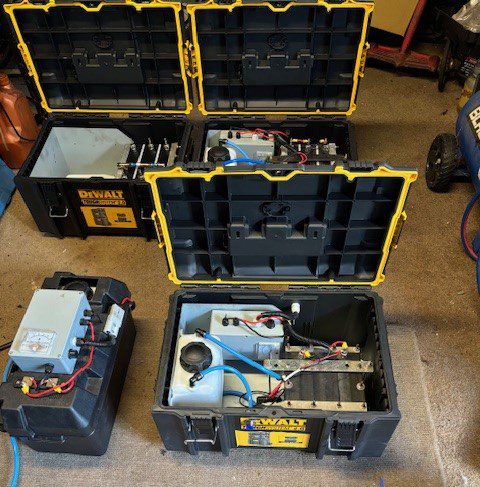
Gen 10 Hydrogen fuel system in Marine Battery Box Enclosure... Full Story
Conversion of a commercial gasoline vehicle to run bi-fuel... Full Story
Hydrogen as Energy Sources—Basic Concepts Nicolae I. Badea ... Full Story
Payment Methods Partner:

© 2023 - Hydrogenfuelsystems pty ltd