Brilliant Invention Gen 20 Hydrogen Generator July 2 2026
Brilliant Invention Gen 20 Hydrogen Generator ---(update Feb 7... Full Story
Perth, West Australia





Application of Hydrogen as Fuel Supplement in Internal Combustion Engines. Faced with the ever increasing cost of conventional fossil fuels and the severe environmental pollution, researchers worldwide are working to cost effectively improve internal combustion engines fuel economy and emission characteristics. Recently, use of hydrogen or hydrogen-rich gas as fuel supplement for SI and CI engines is considered to be one of the potential solutions to these problems. Hydrogen has many excellent combustion properties that can be used for improving hydrocarbon combustion and emissions performance of both SI and CI engines. This article presents a brief review on the recent progress in the application of hydrogen as a fuel additive to improve the efficiencies and emissions of modern IC engines
Read the attached document on testing of Hydrogen in internal combustion engines here
Conclusion
Hydrogen or hydrogen rich gas is a potential fuel supplement in both SI and CI engines to enhance engine performance and improve emission characteristics. Generation of hydrogen in a form called Brown’s gas by electrolysis of water on-board vehicle appears to be a convenient and low cost method. The high burning velocity, wide flammability range, high diffusivity and low ignition diffusivity, low ignition energy and wide flammability limits [4]. The properties of hydrogen in comparison to hydrocarbon fuels are given in Table I [10]. When hydrogen is used as additional fuel, the high diffusivity of hydrogen makes the combustible mixture better premixed with air and more uniform [4]. On ignition by spark plug or compression, its flame front flashes through the engine cylinder at a much higher velocity than in ordinary fuel/air combustion. Because of its very high combustion velocity, hydrogen detonates all the fuel virtually at once. This applies more pressure on the piston in a shorter time interval and most importantly, burns and extracts power from the fuel that previously would have been thrown away through the exhaust. Therefore, hydrogen increases combustion efficiency by forcing the engine to burn hydrocarbon fuel more completely and efficiently. Moreover the wide flammability range of hydrogen allows ultra-lean combustion which dramatically reduces specific fuel consumption [2]. However, in this application, hydrogen contributes an insignificant amount of direct kinetic energy toward moving the engine’s pistons. In other words, HHO delivers its primary benefit by modifying the car’s fuel, not by acting as the car’s fuel.
Hydrogen gas is also found to have similar beneficial effects in the combustion of other fuels. Senthil et al reported an increase in the brake thermal efficiency from 27.3% to a maximum of 29.3% in a compression ignition engine primarily powered by a vegetable oil, namely Jatropha oil [11]. They also noticed significant smoke reduction by 20% and a reduction in UBHC and CO emissions from 130 to 100 ppm and 0.26-0.17% (by volume), respectively, at maximum power output .
Tunestal et al. [12] experimentally proved that addition of hydrogen to natural gas increase the efficiency of the combustion engine as well as. energy are the main characteristics that make hydrogen a potential additive for different type of hydrocarbon fuels.
Tuesday, April 28, 2026

Brilliant Invention Gen 20 Hydrogen Generator ---(update Feb 7... Full Story

by Gavan Knox HFS whats app +61 403177183 gavan@hfuel.com.au... Full Story

Fuel Economy Methodology That Produces Real Numbers - oct... Full Story

Can HHO Improve Towing Economy? Facts That Matter -... Full Story
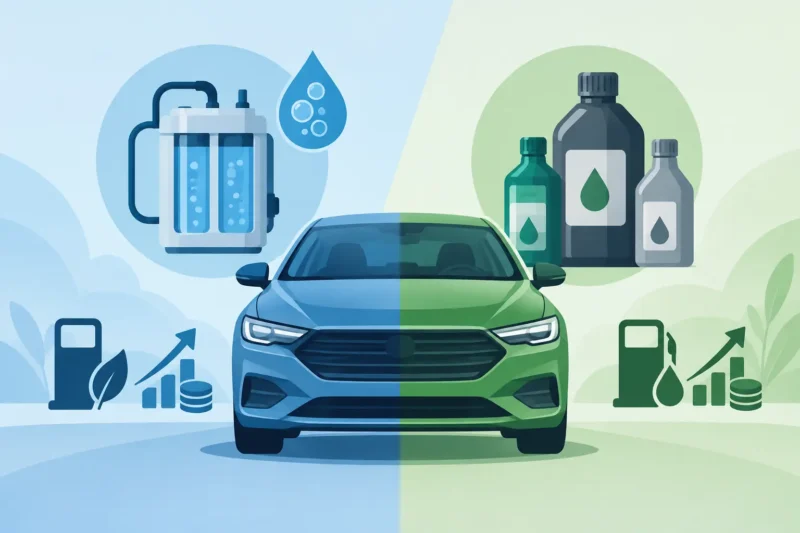
HHO Versus Additives: What Actually Pays Back? - Oct.... Full Story
Payment Methods Partner:

© 2023 - Hydrogenfuelsystems pty ltd