Brilliant Invention Gen 20 Hydrogen Generator July 2 2026
Brilliant Invention Gen 20 Hydrogen Generator ---(update Feb 7... Full Story
Perth, West Australia




by Gavan Knox MSc, BSc, BEd, Inventor
WhatsApp call +61 403177183
contact gavan@hfuel.com.au
https://hydrogenfuelsystems.com.au
Can HHO Affect Engine Sensors? What to Check – oct 1. A modern engine does not guess. It measures air, fuel, boost, temperature and exhaust conditions thousands of times on every trip. That is why owners fitting a hydrogen generator often ask, can HHO affect engine sensors? The direct answer is yes, it can change what some sensors report – but that is not the same as damaging them or needing to trick the ECU.
A correctly installed HHO system supports cleaner, more complete combustion. When combustion changes, the engine management system may see different exhaust oxygen levels, intake pressure behaviour or exhaust temperatures. That is normal. The real issue is whether the kit is sized correctly, fitted cleanly and electrically protected for the vehicle it is working on.
For a diesel work ute, a long-haul truck, a marine engine or a generator burning fuel day after day, getting this part right matters. Good installation protects the vehicle. Poor wiring, air leaks and shortcut tuning create faults that get blamed on HHO.
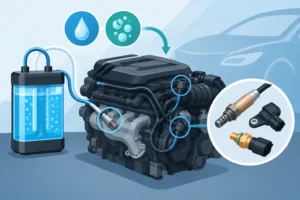
HHO gas enters the intake stream and burns rapidly with the engine’s existing air-fuel charge. It does not coat sensors, replace fuel or override the ECU. Its purpose is to improve the burn quality of the fuel already being used.
That improved combustion can alter sensor readings because the engine is operating differently. On a petrol engine, the oxygen sensors may detect a change in oxygen content in the exhaust and the ECU may make small fuel-trim adjustments. On a diesel, where fuelling is generally not controlled by an oxygen sensor in the same way, changes may be more apparent in exhaust gas temperature, manifold pressure response or soot loading over time.
The key distinction is simple: a sensor reporting a real operating change is doing its job. A fault code, implausible reading or check-engine light is not something to ignore or cover up with an electronic workaround.
Petrol engines use oxygen sensors, often called O2 or lambda sensors, to help the ECU maintain the commanded air-fuel ratio. If HHO helps the mixture burn more completely, exhaust oxygen content can change slightly. The ECU may respond by adjusting short-term and long-term fuel trims.
That does not mean the sensor has been harmed. In fact, a healthy closed-loop system is designed to make these corrections. What matters is that the change stays within the ECU’s normal operating range.
If fuel trims become excessive after installation, look first for an intake leak, an incorrectly positioned gas inlet, a blocked filter, a poor earth or an existing sensor issue. Do not assume the HHO generator is the root cause just because it was the most recent modification.
The mass air flow sensor measures incoming air mass, while the manifold absolute pressure sensor tracks pressure in the intake manifold. These are critical inputs for fuel delivery, boost control and load calculation.
An HHO inlet must be installed so it does not create an unmetered air path, disturb MAF airflow or leak under boost. On turbo diesels especially, the connection must be secure and suitable for the pressure and heat present in the intake tract. A loose fitting after the MAF can create drivability problems, underboost codes or rough idle that have nothing to do with hydrogen itself.
Placement matters. Fit the gas delivery point according to the vehicle-specific instructions, use quality hose and clamps, and keep the system clear of moving parts and high-heat areas. This is workshop discipline, not optional finishing work.
Drivers towing, hauling tools, running 4WDs in soft sand or operating generators under sustained load should watch temperatures. Exhaust gas temperature is a valuable measure of combustion stress, particularly on modified diesels.
HHO can influence combustion speed and burn completeness, so EGT behaviour may change with load. There is no universal result because engine condition, fuelling, boost, driving style and kit sizing all matter. The sensible approach is to establish baseline readings before installation, then compare the same route, load and ambient conditions afterwards.
Intake air and coolant temperature sensors are less likely to be directly affected by the gas itself. However, a badly routed hose or poorly mounted component can expose wiring to heat and vibration. That is an installation problem, and it is entirely preventable.
Late-model diesels may use NOx sensors, differential pressure sensors and temperature sensors to control the emissions system. A cleaner burn may change soot accumulation patterns and regeneration behaviour, but it does not give anyone a licence to bypass a DPF, EGR system or emissions control.
These components are expensive, and they need to remain operational. If the vehicle logs DPF, SCR, NOx or exhaust-temperature faults after any modification, diagnose the fault properly with scan data. Check the wiring, connectors, hoses, exhaust leaks and sensor plausibility before replacing parts.
Most sensor concerns trace back to installation quality rather than the HHO process. A vehicle may already have a tired O2 sensor, dirty MAF, weak alternator, corroded earth or marginal battery. Adding any electrical accessory can expose an existing weakness.
Electrical protection is especially important. The generator should be fused correctly, supplied through suitable relays where required, and connected using sound terminals and cable sized for the current draw. A poor earth can cause voltage drop, unstable accessory operation and confusing fault codes across multiple systems.
Water management also matters. The electrolyte reservoir, lines, filter and non-return protection must be mounted securely and checked regularly. The intake must never be exposed to liquid carryover. HHO is a gas-assist system, not a reason to introduce moisture or contaminants where they do not belong.
Avoid these common shortcuts:
If a system needs sensor signals for control or monitoring, use proper diagrams and proven hardware. Random resistor tricks and so-called sensor spoofers are a poor substitute for correct mechanical installation and ECU-compatible operation.
Before fitting an HHO kit, scan the vehicle for diagnostic trouble codes. Record fuel trims on a petrol engine where scan data allows it, along with idle quality, coolant temperature, charging voltage and any relevant EGT or boost readings. For commercial vehicles, record fuel use over a representative route rather than relying on one short drive.
After installation, inspect every connection with the engine running and, where relevant, under load. Confirm there are no intake leaks, no rubbing hoses, no loose electrical connections and no unexpected warning lights. Then rescan the ECU after a reasonable bedding-in period.
This process protects the owner and provides useful evidence. When a fleet operator can compare the same load, kilometres, fuel use and operating conditions, the conversation shifts from opinion to measurable operating cost.
If the check-engine light appears, the engine surges, fuel trims are extreme, boost drops away or the vehicle enters limp mode, stop guessing. Read the codes and investigate the system methodically. Continuing to drive a hard-working diesel with an active boost or exhaust-temperature issue can turn a small fault into an expensive repair.
Professional help is worth it for late-model common-rail diesels, vehicles with complex emissions systems, tuned engines, marine installations and fleet applications where downtime costs real money. Australian vehicles must also remain compliant with applicable roadworthiness, emissions and electrical requirements.
Hydrogen Fuel Systems kits are intended to be fitted as an engineered combustion-support system, not as a shortcut around sound engine maintenance. Start with a healthy engine, match the system size to the application and follow the installation documentation closely.
The best result comes from a vehicle that is measured before the fit, installed with care and monitored after it goes back to work. Let the sensors do what they were designed to do: show you what the engine is actually doing.
Thursday, October 1, 2026
Brilliant Invention Gen 20 Hydrogen Generator ---(update Feb 7... Full Story

by Gavan Knox HFS whats app +61 403177183 gavan@hfuel.com.au... Full Story
A diesel that is smoking, using more fuel or... Full Story

How Do DC-DC Boost Regulators Affect Hydrogen Gas Production?... Full Story
## Can HHO Affect Engine Sensors? What to Check... Full Story
Payment Methods Partner:

© 2023 - Hydrogenfuelsystems pty ltd